Author: Piero Cingari

  • Small Caps Rally As Credit Fears Ease, Gold Rebounds To $4,350: What’s Moving Markets Monday?

    Small Caps Rally As Credit Fears Ease, Gold Rebounds To $4,350: What’s Moving Markets Monday?

    Wall Street kicked off the week on a strong footing, led by a rebound in small-cap stocks and regional banks, easing some of the credit-driven anxiety that shook markets last week.

    The Russell 2000 Index climbed 1.8% on Monday, outperforming large caps, as the SPDR Regional Banking ETF (NYSE:KRE) rose 2%, extending Friday’s 1.6% gain.

    The recovery comes after KRE plunged 6.2% on Thursday, its worst single-day drop since April, following fresh credit concerns tied to regional lenders.

    Large-cap benchmarks also posted solid gains. The Nasdaq 100 advanced 1.4% to 25,155, just shy of its all-time high of 25,195 set on Oct. 10. The S&P 500 gained 1.1% to 6,733, now within 0.5% of its record, while the Dow Jones Industrial Average added 1% to 46,630.

    Investor attention now turns to a packed earnings calendar. Key reports are due this week from Netflix Inc. (NASDAQ:NFLX), Tesla Inc. (NASDAQ:TSLA), Intel Corp. (NASDAQ:INTC), and International Business Machines Inc. (NYSE:IBM), along with industrial heavyweights GE Aerospace (NYSE:GE), GE Vernova (NYSE:GEV), Raytheon Technologies Corp. (NYSE:RTX) and T-Mobile US Inc. (NASDAQ:TMUS).

    Moderna Inc. (NASDAQ:MRNA) was the top gainer in the S&P 500, jumping over 7%, after announcing that new data on two investigational flu vaccines will be presented at IDWeek 2025, running from Oct. 19–22 in Atlanta.

    On the flip side, Seagate Technology Holdings plc (NASDAQ:STX)—up 145% year-to-date and one of the index’s best performers—was Monday’s biggest loser, as profit-taking pressure that began earlier this month continued to weigh on the stock.

    Gold prices rebounded 2.3% to $4,350, fully recovering Friday’s 1.8% pullback and pushing further into record territory amid ongoing macro uncertainty.

    The biggest surprise came from natural gas, with Henry Hub prices surging over 11% to $3.34, driven by a combination of colder weather forecasts and aggressive short covering.

    Meanwhile, oil extended its slide. West Texas Intermediate (WTI) crude fell 0.8% to $56.70 a barrel, inching closer to April lows of $55.10, the weakest level since February 2021, as surplus concerns continued to pressure the energy market.

    Monday’s Performance In Major US Indices, ETFs

    Major Indices Price %
    Russell 2000 2,497.24 1.8%
    Nasdaq 100 25,174.75 1.4%
    S&P 500 6,741.10 1.2%
    Dow Jones 46,664.30 1.0%
    Updated by 1:10 p.m. ET

    According to Benzinga Pro data:

    • The Vanguard S&P 500 ETF (NYSE:VOO) rose 1.1% to $617.46.
    • The SPDR Dow Jones Industrial Average (NYSE:DIA) rose 1.1% to $466.64.
    • The tech-heavy Invesco QQQ Trust Series (NASDAQ:QQQ) soared 1.4% to $612.33.
    • The iShares Russell 2000 ETF (NYSE:IWM) rallied 1.8% to $247.83.
    • The Technology Select Sector SPDR Fund (NYSE:XLK) outperformed, up 1.4%; the Utilities Select Sector SPDR Fund (NYSE:XLU) lagged, down 0.3%.

    Stocks scheduled to report earnings after the close include W.R. Berkley Corp. (NYSE:WRB), Crown Holdings Inc. (NYSE:CCK), AGNC Investment Corp. (NASDAQ:AGNC), Wintrust Financial Corp. (NASDAQ:WTFC), Zions Bancorporation (NASDAQ:ZION), BOK Financial Corp. (NASDAQ:BOKF), Cleveland-Cliffs Inc. (NYSE:CLF), and Cadence Bank (NYSE:BXS).

    S&P 500’s Top 5 Gainers On Monday

    Company Name % Change
    Moderna, Inc. +7.6%
    Robinhood Markets, Inc. (NASDAQ:HOOD) +7.40%
    Super Micro Computer, Inc. (NASDAQ:SMCI) +7.38%
    ON Semiconductor Corporation (NASDAQ:ON) +5.90%
    Jacobs Solutions Inc. (NYSE:J) +5.40%

    S&P 500’s Top 5 Losers On Monday

    Company Name Chg %
    Seagate Technology Holdings plc (NASDAQ:STX) -4.59%
    Oracle Corporation (NYSE:ORCL) -4.56%
    AppLovin Corporation (NASDAQ:APP) -4.11%
    Western Digital Corporation (NASDAQ:WDC) -3.68%
    Vistra Corp. (NYSE:VST) -3.03%

    Read Next:

    Image created using artificial intelligence via Midjourney.

  • Dimon Sees ‘Cockroaches’ In Banks—Here’s How To Protect Your Portfolio

    Dimon Sees ‘Cockroaches’ In Banks—Here’s How To Protect Your Portfolio

    Fresh fears of mounting credit stress in the U.S. banking system have resurfaced after JPMorgan Chase & Co. (NYSE:JPM) CEO Jamie Dimon issued a stark warning that more financial trouble could be lurking below the surface.

    “When you see one cockroach, there are probably more,” Dimon said during last week’s earnings call, referring to the recent bankruptcies of First Brands—an auto parts maker reportedly under criminal investigation—and Tricolor Holdings, a subprime auto lender.

    On Wednesday, just a day after Dimon’s warning, concerns deepened as Zions Bancorporation (NASDAQ:ZION) disclosed a $50 million charge-off tied to two troubled commercial loans from its California Bank & Trust unit.

    A day later, Western Alliance Bancorporation (NYSE:WAL) revealed it had filed a fraud lawsuit against a borrower, adding to the sector’s unease.

    Now, with regional banks and private equity showing signs of strain, Wall Street is bracing for what could be the next major shock to markets.

    Why Treasury Bonds Could Make A Comeback As Liquidity Tightens

    While many analysts believe these credit issues remain contained, the broader market may still be vulnerable—not because of credit exposure, but because of liquidity.

    Savita Subramanian, head of U.S. equity strategy at Bank of America, says regulated banks today are better capitalized and less likely to spark a full-blown credit crisis.

    However, she cautions that the S&P 500’s high concentration in a few large-cap tech names could make it more sensitive to liquidity shocks.

    That’s echoed by Michael Hartnett, chief investment strategist at Bank of America. In a recent note, he warned that “Krunchy Kredit” cracks are spreading, pointing to weakness in the SPDR Regional Banking ETF (NYSE:KRE), private credit, and the SPDR Insurance ETF (NYSE:KIE).

    He added that if key financial benchmarks drop below critical levels, the Fed could be forced to cut more aggressively.

    Hartnett is also turning bullish on bonds, suggesting that zero-coupon U.S. Treasuries could be the best hedge for credit event risk, with long-dated yields expected to fall below 4% amid Fed easing and global policy shifts away from quantitative tightening.

    The PIMCO 25+ Year Zero Coupon US Treasury Index ETF (NYSE:ZROZ) and the iShares 20+ Year Treasury Bond ETF (NASDAQ:TLT) are up 3.5% and 2.5%, respectively, thus far this month.

    Analysts Also Flag Russell 2000 Puts

    According to Jeff Jacobson, analyst at 22V Research, buying put options on small-cap stocks—tracked by the iShares Russell 2000 ETF (NYSE:IWM)—may be the best hedge if credit stress continues.

    IWM has traditionally had a strong correlation with regional banks (KRE) and private credit, both of which are flashing warning signs.

    Jacobson highlighted that while IWM outperformed both the SPDR S&P 500 ETF Trust (NYSE:SPY) and Invesco QQQ Trust (NASDAQ:QQQ) between August and mid-October, much of that gain was driven by capital goods, health care, software, tech, and utilities.

    At the same time, unprofitable small caps have outperformed their profitable peers—possibly a sign of speculative AI-related flows entering riskier territory.

    This divergence, he notes, could leave IWM vulnerable to a snapback if credit fears deepen and speculative excess unwinds.

    Bottom Line: How to Protect Your Portfolio

    As credit risks resurface—particularly in mid-sized banks and private credit markets—investors should stay on alert.

    Key financial benchmarks like KRE ETF, the Financials Select Sector SPDR Fund (NYSE:XLF), and KIE ETF can offer early signals of deeper stress in the system, and watching their movements may help identify mounting pressure in the sector.

    Long-duration Treasury bonds are increasingly viewed as potential hedges in the event of a broader liquidity stress, offering both safety and potential upside if yields fall further.

    So far, the damage has been limited to a few lenders.

    But if Dimon’s “cockroach” metaphor proves accurate, the market may not be fully priced for what’s still hiding in the shadows.

    Read Next:

    Photo: lev radin / Shutterstock.com

  • China’s Growth Engine Is Sputtering—And Trump’s Tariffs Are To Blame

    China’s Growth Engine Is Sputtering—And Trump’s Tariffs Are To Blame

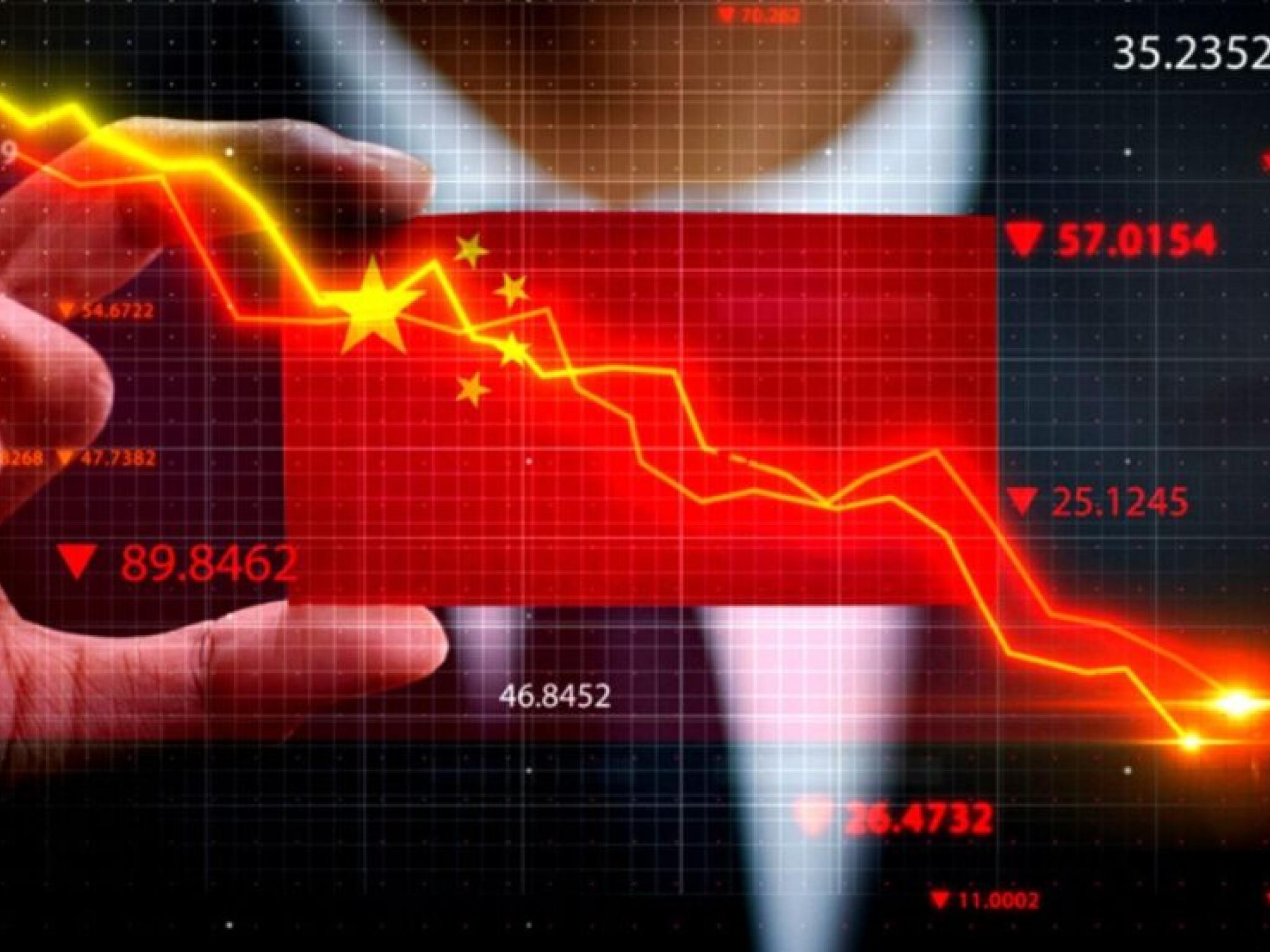
    China’s long-struggling economy is showing fresh signs of distress, as exports to the United States collapse under President Donald Trump‘s tariffs and the property market fails to mount a meaningful recovery.

    According to United Nations Comtrade data, China shipped $35.88 billion worth of goods to the U.S. in July 2025, a staggering 22% drop from the $45.83 billion exported in the same month last year.

    Trump’s Tariffs Bite as China’s Export Machine Slows Down

    China’s tech exports have been decimated. Shipments of smartphones to the U.S. plummeted from $2.3 billion in July 2024 to just $534 million this July—a 77% collapse.

    Laptop exports fared no better, falling from $3.7 billion to $1.69 billion in the same period.

    Even traditionally resilient segments like toys and games saw year-over-year declines. Exports in that category dropped from $3.1 billion to $2.3 billion.

    These drops coincide with a spike in tariffs.

    Unlike Europe, where a 10% stronger euro played a role in weakening export flows to the U.S., China’s export slump stems almost entirely from tariff impacts.

    The Chinese yuan has remained stable against the U.S. dollar, down just 1.5% year-over-year, suggesting minimal currency impact.

    As of October 2025, tariffs on Chinese products currently stand at 30%, and President Trump threatened to add a further 100% starting Nov. 1. In 2024, Chinese exporters to the U.S. faced an average tariff rate of just 10.9%.

    China’s Economic Growth Falters

    The export slump is just one layer of Beijing’s current economic challenge.

    China’s gross domestic product grew 4.8% year-over-year in the third quarter, down from 5.2% in the second quarter. That marks the slowest pace of expansion since the third quarter of 2024 and underscores how the country’s recovery has lost momentum despite targeted stimulus and support measures.

    The slowdown aligns with market expectations but highlights the strain from multiple economic pressures: shrinking exports, soft household spending, and a seemingly endless real estate crisis.

    Consumer spending remains soft despite ongoing efforts by Beijing to stimulate demand. Retail sales rose in September by 3% year-over-year but at the slowest pace in over a year. Unemployment ticked slightly lower but still hovered near a six-month high, weighing on consumer confidence and spending.

    China’s property sector, once the backbone of its economy, remains in the red. According to the National Bureau of Statistics, primary home prices across 70 major cities fell 2.7% month-over-month, annualized in September.

    The downturn was broad-based across all city tiers. Secondary home prices—tracked by the same agency and third-party platforms—have seen much steeper annual declines, ranging from 5% to as much as 20% depending on the region.

    Chinese Tech Stocks Pullback

    The fallout from China’s slowing economy, collapsing export machine and the threat of even higher U.S. tariffs is wreaking havoc on Chinese tech stocks.

    So far in October, the Invesco China Technology ETF (NYSE:CQQQ) has dropped 8%, pacing for its worst monthly performance since January 2024.

    New York-listed shares of Baidu Inc. (NASDAQ:BIDU) are down nearly 9% this month, while Alibaba Group Holding Ltd. (NYSE:BABA) has fallen 7%.

    Read Next:

    Photo: Shutterstock